
Red Army 1941
Strength and Organization of the Red Army at Operation Barbarossa in June 1941. The Red Army in 1941 At the beginning of Operation Barbarossa on June 22, 1941, the Red
Strength and Organization of the Red Army at Operation Barbarossa in June 1941. The Red Army in 1941 At the beginning of Operation Barbarossa on June 22, 1941, the Red
20 Waffen-Grenadier-Division der SS (1st Estonian), 22 SS-Freiwilligen-Kavallerie-Division Maria Theresia (Volunteer cavalry division), 23 Waffen-Gebirgs-Division der SS Kama (2nd Croatian Mountain division), 23 SS-Freiwilligen-Panzer-Grenadier-Division Nederland, 24 SS-Waffen-Gebirgs-Division der SS Karstjaeger

British Army, Home Guard and Canadian troops in Western Europe and Britain in 1940. Strength and organization. The British Army in the first year of the Second World War This

German Orders of Battle shortly after the beginning of Operation Barbarossa on June 27, 1941, in the evening. Russian Campaign 1941 The term ‘Russian campaign’ refers to the invasion of
Campaigns of the 9th SS-Panzer Division Hohenstaufen (Part II). From Arnhem, in the Ardennes and to Hungary to the end of the war. To Part I: 9th SS-Panzer-Division Hohenstaufen. 9th

Jagdpanther (SdKfz 173, tank destroyer for 8.8-cm PaK 43 on Panther chassis), probably the best German tank destroyer of the Second World War. Jagdpanther (SdKfz 173) Heavy tank destroyer (tank

German transport plane Junkers Ju 52/3m ‘Auntie Junkers’ of World War II. History, development, service and dive-bombing tactics, specifications, pictures and 3D model. Transport plane Junkers Ju 52 Junkers Ju

German light tank Mark II (Panzerkampfwagen II Ausf c) History, development, service, specifications, statistics, pictures and 3D model. Panzerkampfwagen II (SdKfz 121) Panzer II Ausf c Type: Light tank. The
Pre-War Pictures from Germany. Here are some pictures taken by a soldier of the Wehrmacht in Germany before WW2. Please click on the pictures to enlarge. Next page: At

Battleship Tirpitz. History, development, service, specifications, pictures and 3D model of the German capital ship of WW2, the ‘Queen of the North’. German battleship Tirpitz Battleship Tirpitz of Bismarck class.

Soviet heavy tank KV: from KV-1 and KV-2 to model 1942. History, development, service, specifications, statistics, pictures and 3D model. KV-1, KV-2, KV-3 Type: Heavy tank and howitzer. Development In

Holocaust, the ‘Final Solution to the Jewish Question’. Wannsee Conference, Gas for Mass Murder, Warsaw Ghetto Uprising, and Hitler’s Role in the Holocaust. Here to the previous part: Final Solution

US M4 Sherman medium tank series with 75 mm gun of WW2. History, development, service, specifications, statistics, pictures and 3D model. Sherman tank M4 Sherman Type: US medium army tank. The

German heavy medium Panther tank. History, development, service, specifications, statistics, pictures and 3D model and action with Panther A in War Thunder. Panzerkampfwagen V Panther Ausf A (SdKfz 171) Panzer

Jagdpanzer 38(t) Hetzer, one of the best German tank destroyers in the Second World War. History, development, service, specifications, statistics, pictures and 3D-model. Jagdpanzer 38(t) Hetzer Jagdpanzer 38(t) Hetzer (‘Baitor’);
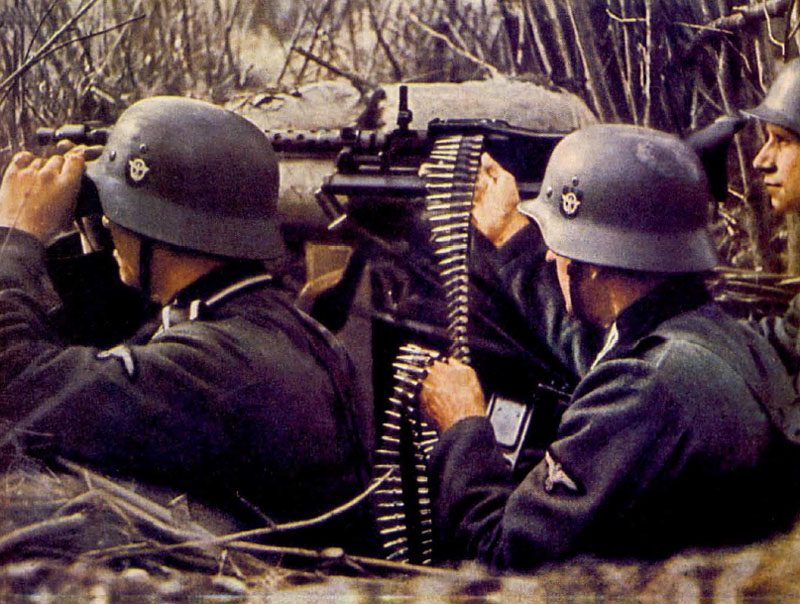
Order of Battle Waffen-SS divisions 4 – 6 (4 SS-Polizei-Panzer-Grenadier-Division, 5 SS-Panzer-Division Wiking (W), 6 SS-Gebirgs-Division Nord). Waffen-SS divisions Polizei, Wiking, Nord Overview Divisions 4 to 6 were part of

Russian Nagant revolvers and Tokarev automatic pistols of the First and Second World Wars. History, development, specifications, statistics and pictures. Russian revolvers and pistols of WWI&WWII Überblick World War I

German Orders of Battle from December 26, 1943. The Russian Front in Winter 43-44 The winter of 1943-44 on the Eastern Front during World War II was marked by significant

Deployment of Anglo-American forces by theaters in summer 1942. Deployment of the armed forces of the Anglo-Americans (Britain with Commonwealth and United States) by theatres of war (Europe, Middle East,

From August 1941 until the end of the Siege of Tobruk in December 1941 (Part III). Australians withdrawn and replaced by Polish troops and ending the siege. From August 1941