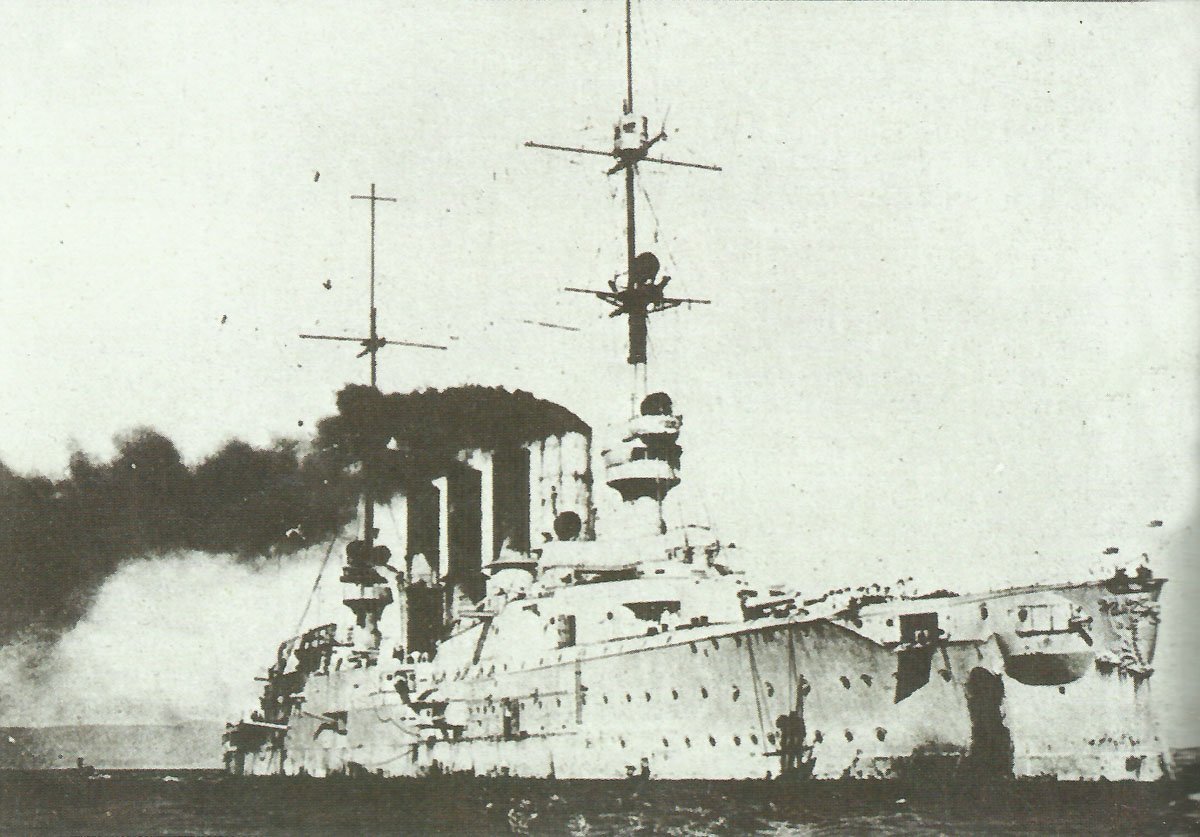

German Armored Cruiser Blücher from World War One, which sunk in the battle of the Dogger Bank 1915.
History, development, service, specifications and pictures
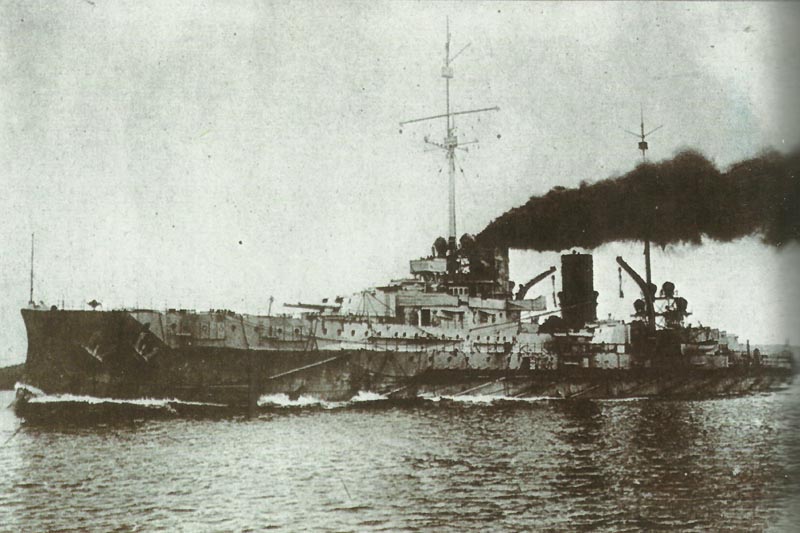
German Armoured Cruiser Blücher from World War One
The German Armoured Cruiser Blücher was a notable warship that served in the Imperial German Navy during World War I.

Overview
Construction: Blücher was laid down in 1907 and launched in 1908. She was commissioned into the German Navy in 1909.
Design: She was the last armored cruiser built by Germany before the advent of battlecruisers. Blücher was larger and more heavily armed than preceding armored cruisers but less well-armed and slower than contemporary battlecruisers.

Specifications:
– Length: 161.8 meters (531 ft)
– Beam: 24.5 meters (80 ft)
– Displacement: 15,842 tons
– Speed: 25.4 knots
Armament: The main armament consisted of twelve 21 cm (8.3 inch) guns in six twin turrets. She also carried secondary armament and torpedo tubes.
Service: Blücher served as a fleet scout and training ship in the years leading up to World War I.
Battle of Dogger Bank: Blücher’s most famous engagement was the Battle of Dogger Bank on January 24, 1915. In this battle, she faced superior British battlecruisers.
Sinking: During the Battle of Dogger Bank, Blücher was heavily damaged by British shells and torpedoes. She eventually capsized and sank with the loss of 792 of her crew.
Legacy: The sinking of Blücher demonstrated the vulnerability of armored cruisers against more modern battlecruisers, influencing naval design and tactics.
The Blücher played a significant role in early World War I naval engagements and her loss was a notable event in the naval history of the conflict.
History of Armoured Cruiser Blücher
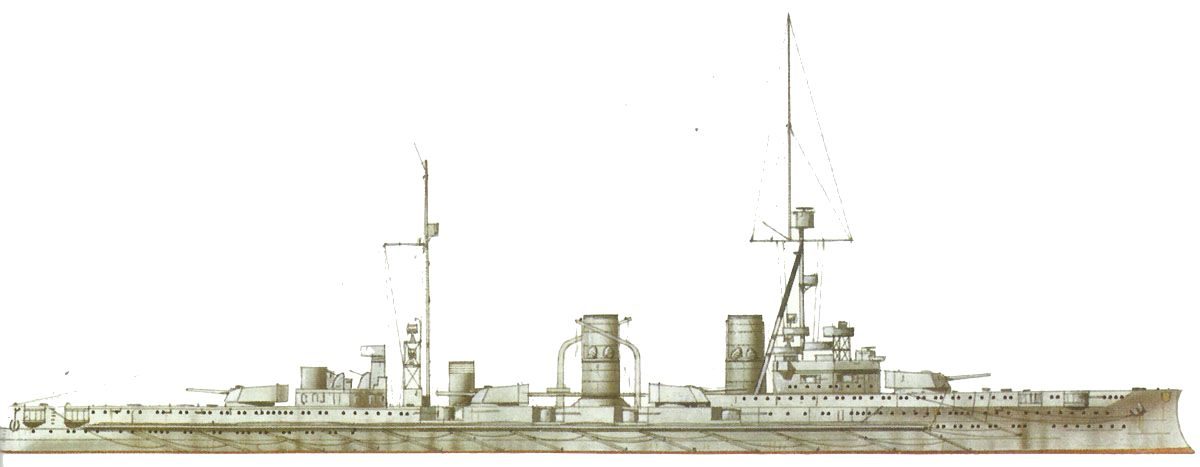
SMS Blücher affords a prime example of a misfit warship produced rapidly to meet a mistakenly perceived threat from a rival power.
The British built their first battle-cruisers in great secrecy, referring to them (deliberately misleadingly) as ‘armored cruisers’.
Of the latter, true current examples were displacing upwards of 13,500 tons, with a mix of 233.7- and 190.5-mm (9.2- and 7.5-in) guns, and it was easy to make the Germans accept the idea of a 16,000-tonner with eight 233.7-mm guns when, in fact, the ‘Invincibles’ were to be 17,230-tonners with eight 304.8-mm (12-in) guns.
Committed to ‘reply’, the uncertain Germans prudently laid down a ‘one-off’, the Blücher. By adopting a 12-gun main battery, set in a six-turret hexagonal layout similar to that of the contemporary ‘Nassau’ class battleships, her designers expected a broadside advantage: not only did their 210-mm (8.27-in) gun out range the British 233.7mm guns, but the available eight-gun broadside weighed nearly 1,134 kg (2,500 lb) against the 862 kg (1,900 lb) of the five 233,7-mm guns expected to bear in a single-gun layout.
On their part the British, stimulated by their own devoutness, credited the Blücher with more than she had. As late as 1908 the authoritative Brassey’s Naval Annual, though properly reporting six turrets, listed them as being four twin and two single 280-mm (l1.02-in) mountings, tempering this with the observation that eight guns of this size ‘at most’ should be expected on the displacement.
Even when the true nature of the ‘Invincibles’ was known, the Germans had little choice but to complete the ship a super armored cruiser with full length belt, two protective decks and a speed of 26 kts. Unfortunately, the Blücher‘s size found her tied to Hipper’s battle-cruiser force despite the fact that her speed and armament were inferior to those of her companies. At the Dogger Bank in 1915 she was placed at the tail of the fleeing German line, slowing it down. As Beatty’s ships came into range their 304.8-mm shells, impacting at steep angles, drilled through both protective decks to guarantee her destruction.
Specifications Armored Cruiser Blücher
Specification:
Blücher | specification |
|---|---|
Displacement | 15,500 tons standard |
Dimensions length | 161,61 m (530,22 ft) |
Dimensions beam | 24,52 m (80.45 ft) |
Dimensions draught | 8,07 m (26,48 ft) |
Propulsion | 3 sets of tripleexpansion steam engines delivering 32,811 kW (44,000 ihp) to three shafts |
Speed | 26 kts |
Main Armament | 12 x 21O-mm (8.27-in) guns |
Secondary Armament | 8 x 150-mm (5.91-in), 16 x 88-mm (3.46-in) guns |
Torpedo tubes | 3 x 450-mm (17.72-in) |
Armour belt | 185 mm (7.28 in) tapering to 90 mm (3.54 in) |
Armour upper protective deck | 36 mm (1.38 in) |
Armour lower protective deck | 50 mm (1.97 in) |
Armour barbettes | 150 mm (5.91 in) |
Complement | 850 |
Vice Admiral Franz von Hipper
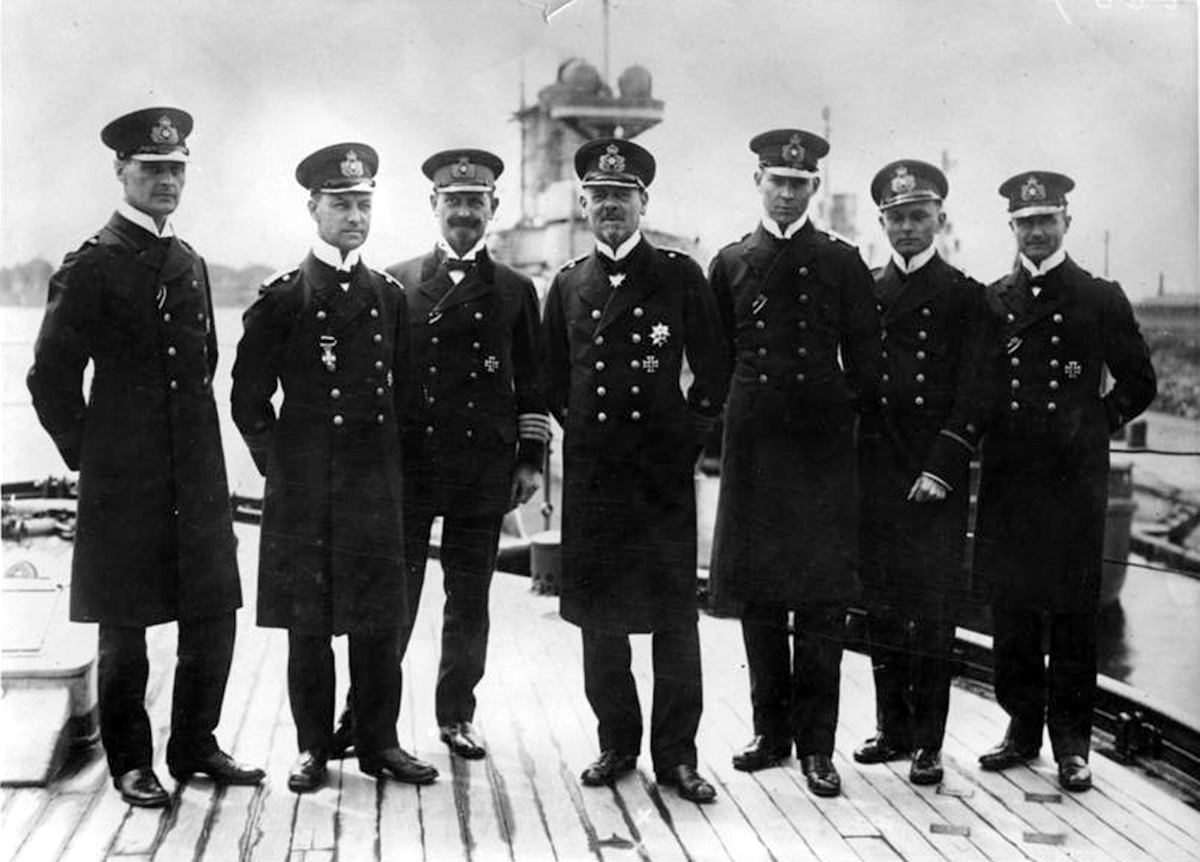
Vice Admiral Franz von Hipper (1863–1932) was a senior German naval commander during World War I and one of the most prominent leaders of the Imperial German Navy (Kaiserliche Marine). He is best remembered for commanding Germany’s battlecruiser forces and for his key role in major naval engagements against the British Royal Navy.
Early Life and Naval Career
– Born: 13 September 1863, Weilheim in Oberbayern, Kingdom of Bavaria
– Died: 25 May 1932, Altona (now part of Hamburg)
Hipper joined the German Navy in 1881, rising steadily through the ranks. He gained experience in torpedo boats, cruisers, and staff positions, earning a reputation as a capable and disciplined officer.
World War I and the Battlecruiser Fleet
At the outbreak of World War I, Hipper commanded the I Scouting Group, Germany’s battlecruiser squadron. His force included some of the most powerful ships in the German fleet, such as SMS Seydlitz, Moltke, Derfflinger, and Lützow.
He played a central role in several major naval battles:
Battle of Heligoland Bight (1914)
Hipper led German reinforcements that helped drive off British forces, preventing a potentially disastrous defeat for the German navy early in the war.
Raid on Scarborough, Hartlepool, and Whitby (1914)
Hipper commanded the battlecruisers during this controversial coastal raid on England, aimed at drawing out parts of the Royal Navy and boosting German morale.
Battle of Dogger Bank (1915)
During this engagement, Hipper’s flagship SMS Seydlitz was badly damaged but survived due to effective damage control. The battle exposed weaknesses in German command coordination but also demonstrated the resilience of German ships.
Battle of Jutland (1916)
Hipper commanded the German battlecruisers during the largest naval battle of the war. His ships fought British battlecruisers under Admiral David Beatty, inflicting heavy losses. Hipper’s flagship SMS Lützow was fatally damaged, forcing him to transfer between ships during the battle. His performance at Jutland earned him high praise and Germany’s highest military honor.
Promotion and Later War Service
In August 1916, Hipper was promoted to Admiral and later succeeded Reinhard Scheer as commander of the High Seas Fleet in 1918. However, by this stage of the war, Germany’s naval strategy was increasingly constrained by political realities and declining morale.
Hipper opposed the planned final fleet sortie in October 1918, which he believed would lead to unnecessary losses. The plan contributed to widespread mutinies, accelerating the collapse of Imperial Germany.
Awards and Recognition
– Pour le Mérite (Germany’s highest military decoration)
– Numerous German and foreign honors
Retirement and Death
After the war, Franz von Hipper retired from naval service and lived quietly, avoiding political involvement. He died in 1932 and was buried without great ceremony, reflecting his modest personal character.
Legacy
Franz von Hipper is remembered as one of Germany’s most skilled naval tacticians of World War I. While he never achieved a decisive naval victory over Britain, his leadership at Jutland and his command of Germany’s battlecruisers secured his place among the most important naval figures of the era.
References and literature
The Illustrated Encyclopedia of Weapons of World War I (Chris Bishop)
An Illustrated History of the Weapons of World War One (Ian Westwell)
Jane’s Fighting Ships of Word War I
The Illustrated Directory of Warships from 1860 to the present day (David Miller)
Atlas zur Seefahrts-Geschichte (Christopher Loyd)
Seemacht – eine Seekriegsgeschichte von der Antike bis zur Gegenwart (Elmar B. Potter, Admiral Chester W.Nimitz)