
Italian fighters Fiat G.50 Freccia to G.55 Centauro.
History, development, service, specifications, statistics, pictures and 3D model.
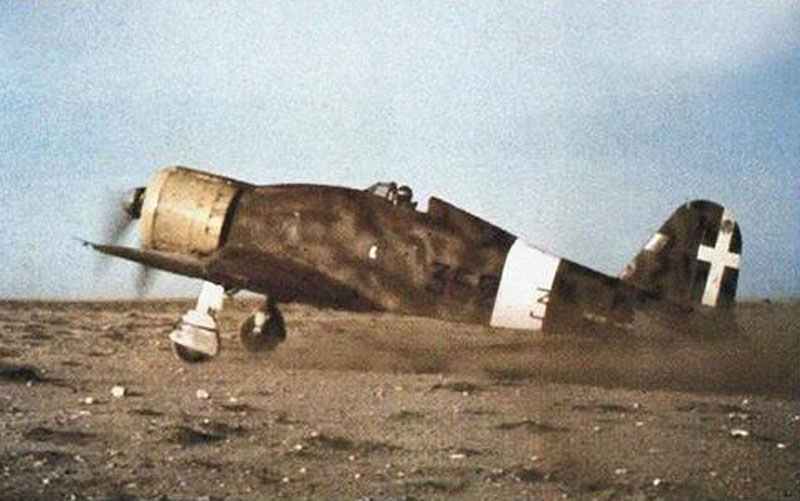
Fiat G 50 – G 55
Fiat G 50 Freccia, G 50bis, G 50ter, G 55 Centauro.
Type: Italian WW2 fighters from Fiat.

History
In 1935 this challenge of requirements to have an all-metal monoplane fighter for the Regia Aeronautica brought in no less than 6 contending concepts. However, the Macchi 200 appeared to be in the end to generally be principal, the first champion was the Fiat G.50, the earliest significant pattern by engineer Giuseppe Gabrielli (therefore, the naming).
The flight tests proceeded to go easily, an acquisition was placed in September 1937 regarding 45 and deliveries started at the beginning of 1938.

Around a 12 of the initial manufacturing G.50s were shipped to strengthen the Aviazione Legionaria in Spain, where their excellent characteristics of speed and maneuverability were obvious.
However, aviators resented using a sliding cockpit canopy, which was hard to open promptly and interfered with vision, and in the following manufacturing batch of 200 an open cockpit was implemented. The weak armament wasn’t improved, but fairings for the retracted wheels were included.
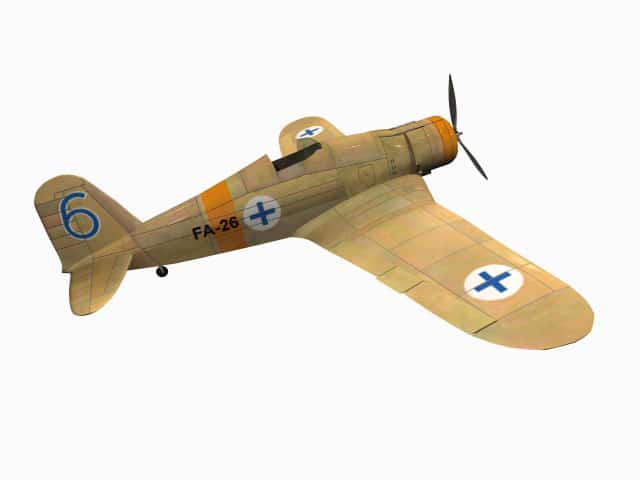
Manufacturing from the CMASA factory at Marina di Pisa got under way in 1939, with deliveries replacing the CR.32 in Regia Aeronautica fighter squadrons (not necessarily to the pilots’ pleasure), along with an even more 35 being delivered to Finland in 1940 where they provided excellent action versus Russian planes.
The primary manufacturing model was the G.50bis, with profiled fuselage providing increased pilot view, armor and self-sealing tanks. About 450 were built usually by CMASA.
Additional variants contained the tandem-seat G.50B trainer, of which 139 were produced; the G.50ter with increased powerful engine; and prototypes of the G.50bis-A with 4 x 12.7 mm machine guns as well as racks for 2 bombs, and also of the German DB 601A-powered G.50V, which resulted in the Fiat G.55 Centauro.
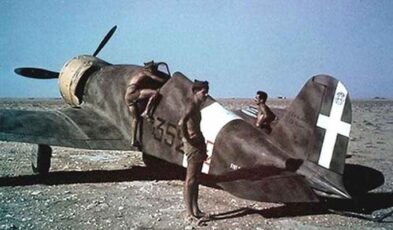
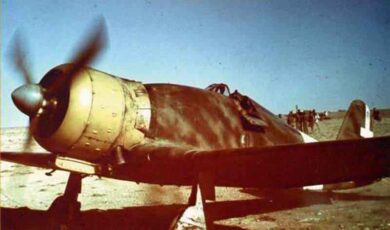
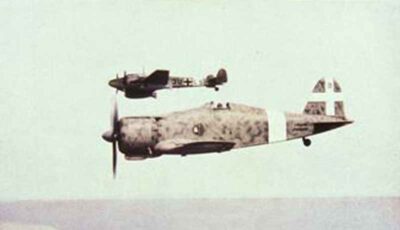
Just 105 of the powerful Fiat G.55 Centauro were built till the end of WW2.
Users: Italy, Finland, Spain.
Specifications Fiat G.50 Freccia
Specifications:
Fiat G.50 Freccia | Specification |
|---|---|
Type | fighter plane |
Power plant | one 840 hp Fiat A.74 RC38 14-cylinder two-row radial engine |
Accommodation | 1 |
Wing span | 36 ft |
Length overall | 25 ft 7 in |
Height overall | 9 ft 8 in |
Weight empty | 4,188 lb |
Weight loaded | 5,966 lb |
Maximum speed | 293 mph |
Initial climb | 2,400 ft/min |
Service ceiling | 32,810 ft |
Range | 621 miles |
Armament:
Fiat G.50 Freccia | Specification |
|---|---|
above front fuselage | 2 x 12.7mm Breda-SAFAT machine guns |

Service statistics:
Fiat G.50 Freccia | figures |
|---|---|
First flight | 26 February 1937 |
Production delivery | September 1937 |
Final delivery | 1945 (Fiat G.55 Centauro) |
Total production figure (all) | 782 (105 Fiat G.55 Centauro) |
3D Model Italian WW2 fighter Fiat G.50 Freccia
Fiat G.55 Centauro: Italy’s Best Fighter of World War II
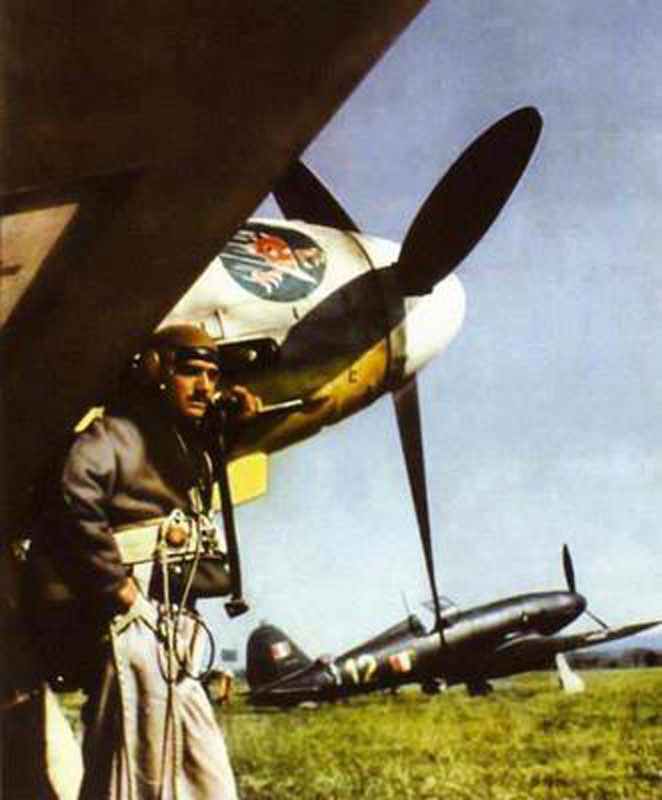
The Fiat G.55 Centauro (Centaur) stands as one of the finest Italian fighter aircraft of World War II, and arguably one of the best fighters produced by any nation during the conflict. Despite arriving late in the war, this sleek, powerful aircraft left an indelible mark on aviation history.
Development and Design
Designed by Giuseppe Gabrielli at Fiat Aviazione, the G.55 was developed as part of Italy’s “Serie 5” fighters—a new generation of Italian aircraft powered by the German Daimler-Benz DB 605 engine. The prototype first flew on April 30, 1942, and immediately impressed test pilots with its performance and handling characteristics.
Key Features:
– Engine: Fiat RA.1050 RC.58 Tifone (license-built DB 605A-1), producing 1,475 hp
– Maximum Speed: 620 km/h (385 mph) at 7,400 meters
– Range: 1,200 km (746 miles)
– Armament: Three 20mm MG 151/20 cannons and two 12.7mm Breda-SAFAT machine guns
– Wingspan: 11.85 meters (38 ft 11 in)
The G.55 featured a low-wing monoplane design with an enclosed cockpit, retractable landing gear, and excellent visibility for the pilot. Its robust construction allowed it to carry significant armament while maintaining exceptional maneuverability.
Combat Performance
The Centauro entered service with the Regia Aeronautica in mid-1943, just months before Italy’s armistice with the Allies in September 1943. Despite limited production numbers—only about 105 were built during the war—the aircraft proved itself in combat.
Strengths:
– Superior maneuverability at all altitudes
– Excellent diving characteristics
– Heavy firepower with centrally-mounted cannons
– Robust airframe that could absorb significant damage
– Good high-altitude performance
German Luftwaffe pilots who evaluated the G.55 alongside its contemporaries (the Macchi C.205 and Reggiane Re.2005) praised it highly. Some German assessments ranked it among the best fighters of the war, comparable to the Bf 109G and Fw 190.
Service History
With the Regia Aeronautica
The G.55 initially served with Italian fighter squadrons defending against Allied bombing raids over northern Italy. Pilots praised its handling and firepower, though production challenges limited its availability.
With the Aeronautica Nazionale Repubblicana (ANR)
After Italy’s split in 1943, the German-aligned Italian Social Republic (RSI) received the majority of G.55 production. The aircraft served with the ANR, particularly with elite units like:
– 1° Gruppo Caccia “Asso di Bastoni”
– 2° Gruppo Caccia “Gigi Tre Osei”
These squadrons flew the Centauro in defense of northern Italy against American and British bombers until the war’s end.
Post-War Service
Interestingly, the G.55’s story didn’t end in 1945. Argentina purchased the manufacturing rights and produced the aircraft post-war as the I.Ae. 27 Pulqui, while Egypt also operated G.55s into the 1950s, including during the 1948 Arab-Israeli War.
Variants
– G.55/0 (Serie 0): Pre-production model with three 20mm cannons
– G.55/I (Serie I): Main production variant with improved armament
– G.55A: Single-seat fighter-bomber variant
– G.55B: Two-seat advanced trainer (post-war)
– G.55S: Torpedo-bomber variant (prototype only)
Legacy
The Fiat G.55 Centauro represents what Italian aviation could have achieved had it received proper support and resources earlier in the war. Aviation historians consistently rank it among the top five Italian aircraft designs of all time.
Why It Matters:
– Demonstrated Italian engineering excellence at its peak
– Proved competitive with the best Allied and Axis fighters
– Influenced post-war Argentine fighter development
– Showed that Italy could produce world-class combat aircraft when given proper engines and resources
Technical Comparison
When compared to its contemporaries:
– vs. Bf 109G: Better maneuverability, similar speed
– vs. P-51D Mustang: Comparable performance at medium altitudes
– vs. Spitfire Mk. IX: Similar capabilities in dogfighting
– vs. Fw 190A: More maneuverable, slightly slower
Conclusion
The Fiat G.55 Centauro remains a testament to Italian aeronautical engineering prowess during World War II. Had it entered service earlier and in larger numbers, it might have significantly impacted the air war over the Mediterranean and Italy. Today, the few surviving examples stand as reminders of one of aviation’s most elegant and capable fighters—a machine that arrived too late but performed brilliantly nonetheless.
The Fiat G.55 Centauro represents the pinnacle of Italian piston-engine fighter design, a worthy rival to any fighter in the skies during the final years of World War II.
References and literature
Luftkrieg (Piekalkiewicz)
Das große Buch der Luftkämpfe (Ian Parsons)
Combat Aircraft of World War II (Bill Gunston)
World Aircraft World War II (Enzo Angelucci, Paolo Matricardi)